Cutting, folding, kisscutting, creasing and perforating machines, corner rounders, cylinder dye cutters and everithing you need to finish your printed material, direct from manufacturer...
Now we've equipped this electric paper punch with a feeder unit. In this video the device sticks two rolls of hook and loop Velcro tapes together and cuts them into the desired length.
Certainly you can not only cut with this device. In the next video we test the device with a steel rule die and with a quite a special task.
Because there is little space left in the machine we couldn't use the usual programmable logical controller, we used an Arduino micro controller. So there is no display for setting the parameters, you can do it with your smartphone. Perhaps the younger generation will prefer this solution?
The Paperfox FTD-1 tape applicator can apply self adhesive tapes up to 20mm width. Now we developed a new tape applicator head prototype which can lay up to 50mm wide tapes.
The new taping head can be used in the FTD-1 similarly as the standard TD-1 head. The 50mm wide tape requires more force to cut so we made a stronger adjustable spring to hold the sheets when the knife cuts the tape.
How can you get a nice creasing without cracks? How can you crease and fold sensitive digital prints, laminated or varnished sheets? A lot of factors will determine the quality of creasing.
Paper with a grammage above 150 g/m2 should be creased before folding. The most common way of creasing is the flat-bed creasing machine. The creasing should be parallel to the fibre direction of the paper, but is not always possible. The geometry of the creasing tool (2), the creasing rule (4 and the creasing pressure are crucial for achieving the best result.
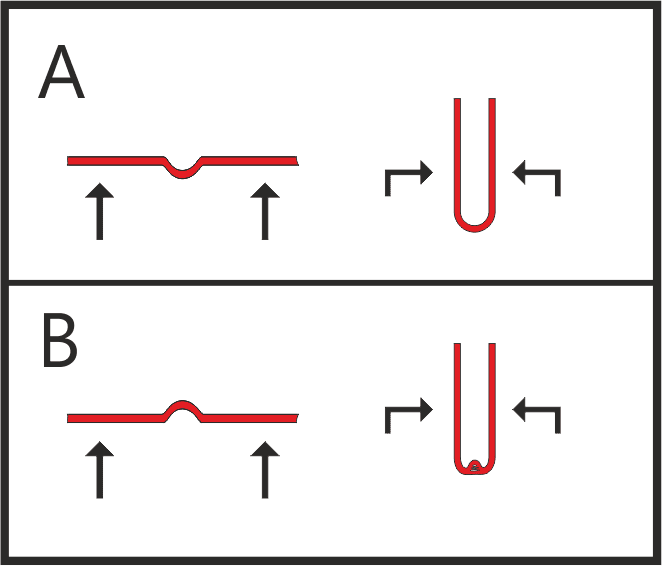
The direction of folding is a very important factor. You can fold thinner sheets in direction "A" without any problem, but sometimes the direction "B" (traditional method) gives a better result. The advantage of direction "B" that it "delaminates" the layers, and the layers can slide undamaged. Unfortunately modern papers not always acting in traditional way.
Folding direction after creasing
If the shape of the tool and the creasing rule are not ideal for the material to crease, then the paint or the varnish cracks, or the lamination peels off.
The paint cracks on the paper
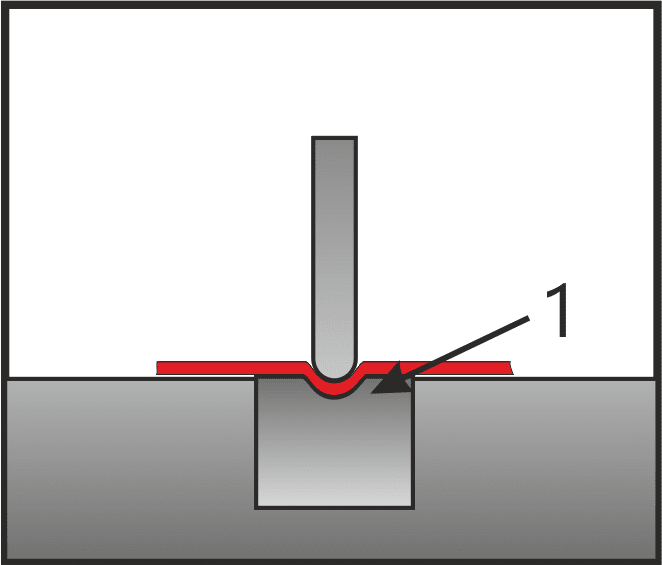
To achieve better crease you can use rubber instead of the creasing rule. In this way the paper follows the shape of the creasing rule, it supports the paint reducing the cracking effect. This creasing method applied for example in the Paperfox KB-32 creasing machine.
1. Rubber
If the material is so sensitive that it cracks anyway, you can kiss cut the cardboard. In this way you can achieve acceptable result even if the other solutions don't work. In this way you can "crease" plastic, leather or other materials as well. Although the strength of the folding is not the best, this solution produces the flattest folding.
There are some folding samples in the following picture with a very sensitive material.
By scoring the sheet runs through a pair of rotating tool which is much more quicker as the traditional methods. Unfortunately the cracking effect even worse than by flatbed machines.
In this case a simple solution provides the best solution. Just wrap some insulation tape on the rotating cylinder under the creasing roller and it helps similar way as the rubber creasing rule at flatbed machines. That's way you can make a perfect creasing with a Paperfox R-761 Kisscutting, creasing, perforating machine.
You don't need to use paper cores to rewind paper, plastic foil, corrugated paper or other similar roll materials, because we've developed the Paperfox CLR-5 coreless rewinder.
Thanks to a completely new operating principle, the machine is smaller, lighter and cheaper than any other similar device.
The Paperfox CLR-5 coreless rewinder can rewind roll materials up to 70cm width. The length to rewind and some other parameters can be set with a programmable controller.
How is it made?
First we tried to solve the problem in a traditional way. The machine was big, heavy and it had a lot of expensive components. In addition it don't worked well with all kind of paper.
Then we find out a completly new solution to this task. In the following video you can see our first trial to test the new principle:
The test was successful, so we created the first working prototype:
Then we reduced the size and applied a programmable controller to adjust the desired length to rewind and some other parameters.
The construction is still subject to change, we are open to any suggestions.
I hope it'll be a very successful product in the future.
Paper is our world!
In several small and big printing and binding companies all over the world working PAPERFOX machines every day for the best statisfication of our clients.
Zoltán Fürcht
"Each of my clients knows Paperfox as a reliable supplier of powerful and durable equipment.
As Hungarian entrepreneurs, I am proud that the expertise of my staff, not only in our country estimated.
Many customers from all over Europe producing with our devices mailings, flyers, presentation folders, packaging materials, etc..
I would like to take this opportunity to thank you for your loyalty and the many recommendations. "
Zoltan Fürcht
and the whole Paperfox Team